Battery storage for commerce and industry
Battery storage for commerce and industry in Switzerland: cap load peaks, use your own solar power, market balancing energy. Sized to your load profile.
Your load peaks cost you five figures per year, with no return.
A battery storage system for commerce and industry lowers your demand charge by CHF 108 per kilowatt capped and year (2026 median, ElCom), raises the self-consumption of your solar plant and earns revenue on the balancing energy market in a pool.
We plan and build battery storage in Switzerland, independent of any manufacturer and with lithium iron phosphate cells (LFP). Power and capacity follow from your load profile, not from a rule of thumb. To date, Ampere Dynamic has installed over 3 MWh of storage capacity.
Key Takeaways
6 min read
Key Takeaways
6 min read- Lower the demand charge for good 100 kW less peak saves around CHF 10'800 a year at the 2026 median demand charge (ElCom tariff data, profile C6).
- Size from the load profile Power in kW follows from the peak above the base load, capacity in kWh from how long it lasts. The basis is twelve months of load profile in 15-minute values.
- Self-consumption of 70–90% Instead of feeding solar power in at 3.9–10.3 Rp./kWh, you use it yourself and avoid grid purchase at 20–30 Rp./kWh.
- Payback in 4–6 years With combined use of several revenue sources (evaluation of completed Ampere Dynamic industrial projects). Kuny AG shows what the sizing looks like in practice.
How large your battery storage system needs to be
Two figures define the system: power in kW and capacity in kWh. We read both from your load profile.
The power has to cover the peak you want to cap, that is the part of your draw above the base load. The capacity has to last until the peak is over and absorb the solar surplus you want to use in the evening or on the night shift. The basis is the load profile of the last twelve months in 15-minute values, as the grid operator meters it for billing.
The ratio of the two is called the C-rate. A system at 0.5C delivers its full power for around two hours. For short, high peaks power matters most, for shifting solar power it is capacity. If you also want to offer balancing energy, part of the capacity is reserved for it.
A system designed for peak shaving alone stands idle for most of the month. That is why we design it for several applications at once.
How a battery storage system earns money for a business
Three revenue sources carry the business case, served by the same system. The energy management system gives peak shaving priority, because it lowers the demand charge directly.
Since 1 January 2026, a refund of the grid usage charge can be requested for electricity that is drawn from the grid, stored and fed back (StromVG Art. 14a). Depending on the business, further applications come on top: buffering charging power for electric vehicles, avoiding an upgrade of the grid connection, supplying critical loads during a grid outage.
The mechanics of peak capping are explained in the guide Peak shaving with battery storage, marketing in a pool in the article Balancing energy with battery storage. The comparison with a grid upgrade is calculated in Battery storage vs grid expansion.
What determines the investment in a battery storage system
Five factors determine the price of a battery storage system. We name a figure only once your load profile and your site are known.
- Power and capacity. Both follow from the sizing; a reserve for balancing energy increases the capacity.
- Site. Outdoors on foundations, on a roof or inside the building. A roof site needs a structural check and a crane.
- Grid connection and metering. The grid operator sets the technical conditions under its own connection rules and the VSE storage handbook; on top come the meter at the grid connection point and, where needed, a limit on feed-in power.
- Permit and fire protection. Building permit under the rules of the municipality and clarification with the cantonal building insurer.
- Energy management. The EMS controls storage and solar plant and, where balancing energy is planned, connects both to the marketing platform.
How the revenue sources add up to a payback and what to look for when comparing offers is explained in our guide to commercial battery storage.
Example from practice: Kuny AG in Küttigen
Kuny AG makes textile tapes in Küttigen AG and has run a 633 kWp solar plant built by Ampere Dynamic since December 2022. Since March 2026, two LFP storage units with a combined 250 kW and 522 kWh complement the plant.
Starting point. The 2024 load profile showed peaks of over 400 kW, and around 262 MWh of solar power flowed into the grid. Sizing. The 250 kW of discharge power is the upper limit of what the system can take out of a peak; the 522 kWh last for around two hours at full power and absorb solar surplus for production during the day. Operation. The EMS caps peaks and optimises self-consumption; the system is registered for ancillary services, planned mainly at night and at weekends. Measured values for the peak reduction achieved are not yet available (Ampere Dynamic project data).
Ampere Dynamic’s largest storage project stands at Post Immobilien AG in Untervaz: 2 MWh and 1’000 kW, designed to support the local grid.
Frequently asked questions
How large does a battery storage system for a business need to be?
Your load profile decides, not the size of the solar plant. The power in kW has to cover the part of the peak above the base load that you want to cap. The capacity in kWh has to last until the peak is over and absorb the solar surplus you want to use later. Kuny AG, with peaks of over 400 kW, runs a system of 250 kW and 522 kWh.
How does a battery storage system earn money for a business?
Through three revenue sources in the same system. Peak shaving lowers the demand charge, at the 2026 median by around CHF 10'800 a year per 100 kW of peak capped (ElCom tariff data). Self-consumption replaces grid power at 20 to 30 Rp./kWh with your own solar power. Marketed in a pool with other plants, the system also earns revenue on the balancing energy market.
What determines the investment in a battery storage system?
Five factors: power and capacity, the site (outdoors, on a roof or inside the building), grid connection and metering concept, permit and fire protection, and integration into the energy management system. We name a price only after analysing your load profile, because these factors differ from site to site.
In how many years does a battery storage system pay for itself in a business?
In 4 to 6 years with combined use of several revenue sources (evaluation of completed Ampere Dynamic industrial projects). What counts is your load profile, your grid operator's demand charge and the revenue sources you use. A system that only caps peaks stands idle for most of the month and pays back more slowly.
Which cell technology do you use?
We use lithium iron phosphate (LFP): thermally stable, cobalt-free and rated for up to 8'000 cycles according to the datasheets of the cell manufacturers CATL and BYD. The systems stand outdoors or as a cabinet inside the building, depending on space and fire protection. We keep assessing new cell chemistries, independent of any manufacturer.
From analysis to ongoing operations
Ampere Dynamic accompanies you from the analysis to the ongoing operation of your battery storage system.
Profitability analysis
We analyse your load profile, identify savings potential and create a detailed profitability calculation.
- Evaluation of your consumption data
- Identification of load peaks
- ROI calculation and payback period
- Subsidy review
Concept & planning
Based on the analysis, we develop a tailored concept. We take your specific requirements and future developments into account.
- System dimensioning
- Manufacturer-independent technology selection
- Integration with existing systems
- Detailed offer creation
Installation & commissioning
Our experienced team handles the complete installation. From building permit to grid registration: everything from a single source.
- Approval management
- Professional installation
- Grid connection and registration
- Commissioning and testing
Operations & monitoring
After commissioning, we continuously monitor your system. Maintenance, performance optimisation and technical support, for maximum availability.
- Remote monitoring
- Regular maintenance
- Performance reporting
- Technical support
Two examples from our project practice
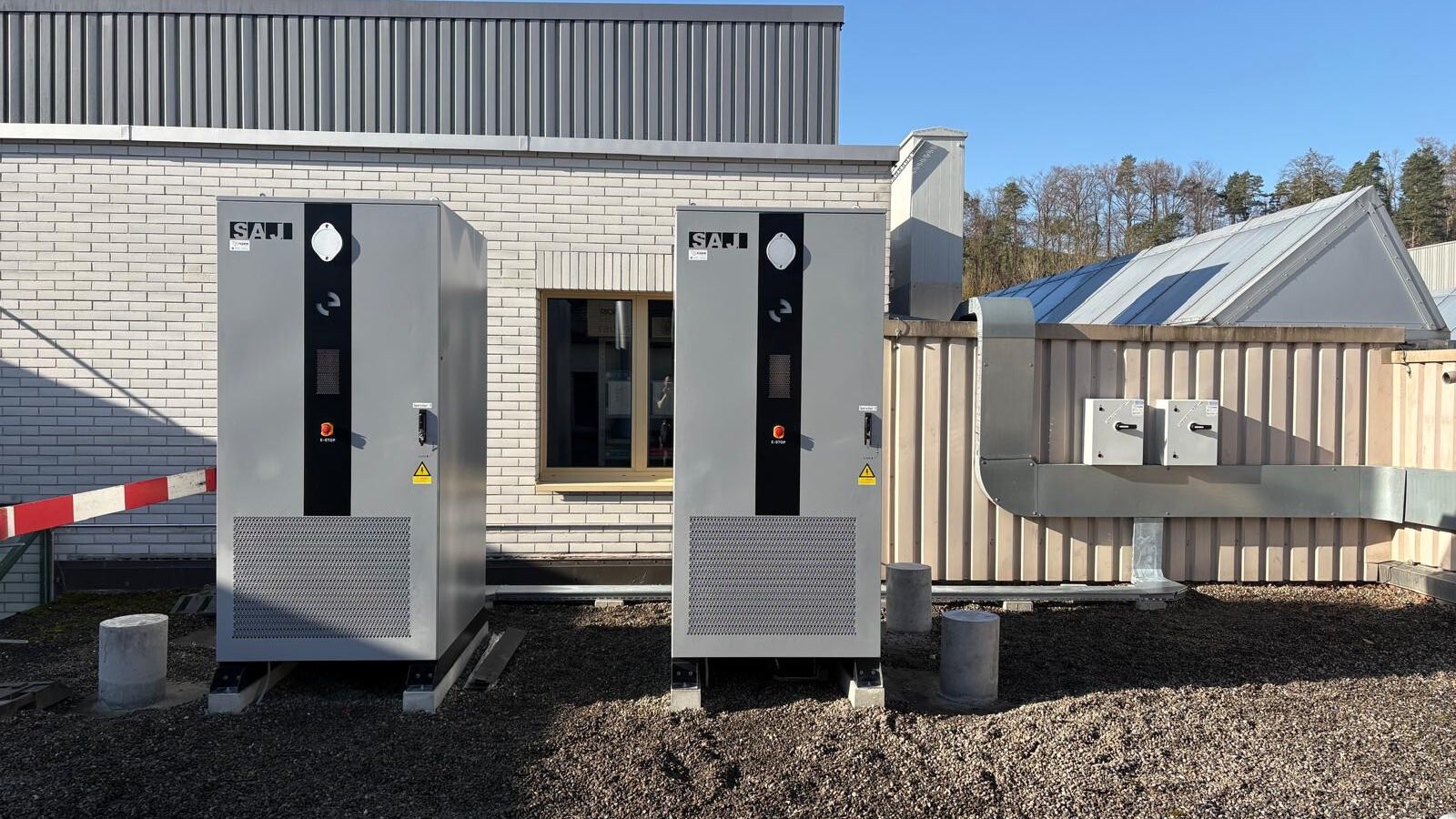
Kuny AG
Two LFP storage units on the existing 633 kWp solar plant: self-consumption and peak shaving by day, registered for ancillary services.
Zum Projekt →
Die Post
Ampere Dynamic's largest battery storage system: 2 MWh and 1'000 kW to support the grid, combined with 264 kWp of façade PV in Untervaz.
Zum Projekt →Certified and award-winning


Swiss Logistics Award 2024 for the high-tech charging infrastructure for electric trucks at the Hugelshofer Group, one of the largest in Europe (as of 2024), delivered by Ampere Dynamic together with partners.